Comparison of antioxidant compounds of green betel (Piper betle) and red betel (Piper crocatum) extracts using different solvents with the DPPH method
DOI:
https://doi.org/10.34310/jbsh.v1.i2.79Keywords:
Green betel leaf (Piper betle); red betel leaf (Piper crocatum); 70% ethanol; 70% methanol; DPPHAbstract
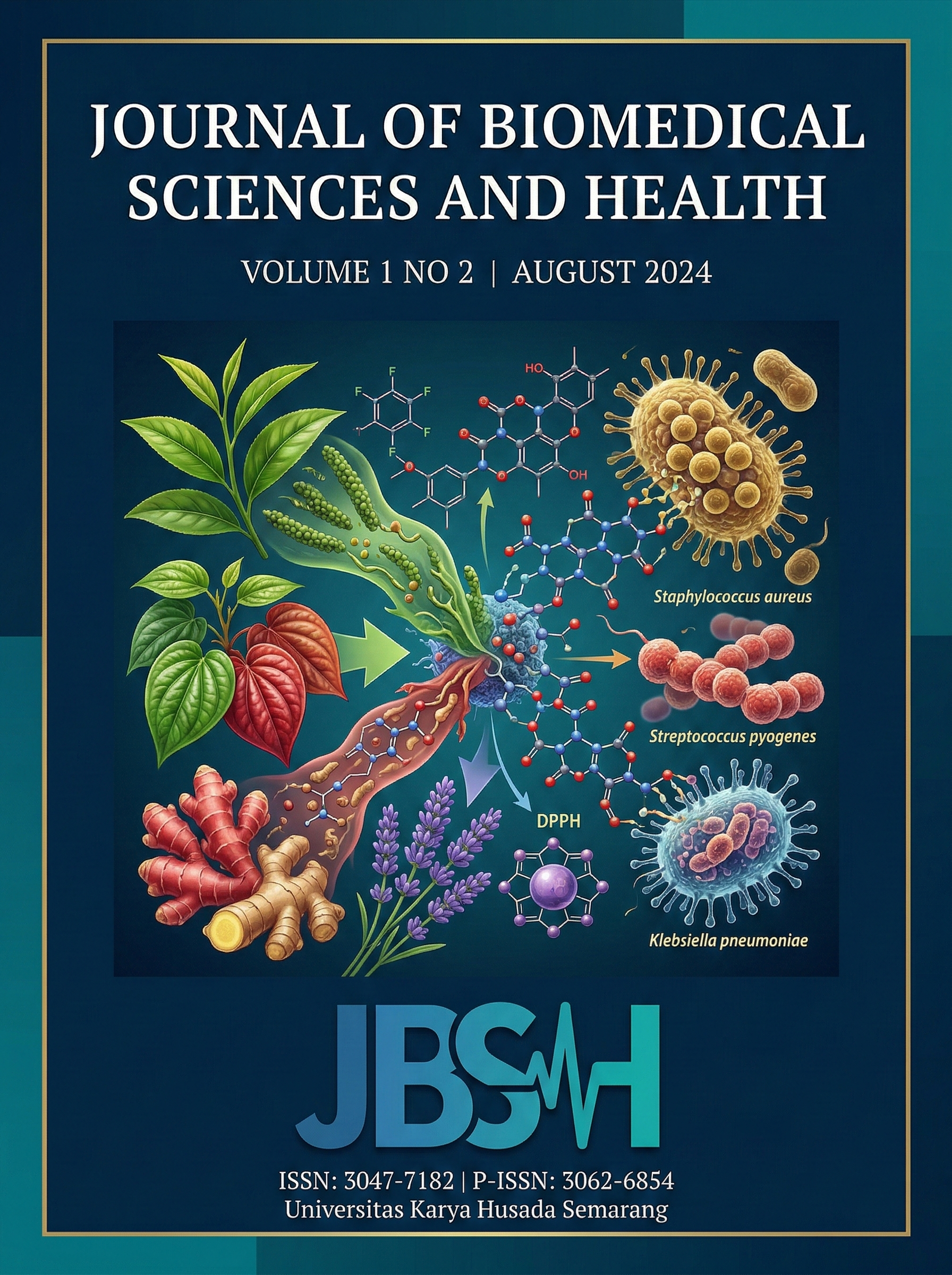
Background: Green betel (Piper betle) and red betel (Piper crocatum) leaves are widely reported to contain flavonoids, tannins, alkaloids, and saponins, compounds empirically linked to free-radical scavenging activity, yet a direct, quantitative comparison of their antioxidant strength across two polar solvents remains scarce. Objective: To compare the phytochemical content and antioxidant activity of green and red betel leaf extracts using 70% ethanol and 70% methanol via the DPPH method. Method: This laboratory-experimental study was conducted at the Biomedical Science Laboratory, Universitas Karya Husada Semarang, from 22–28 February 2024 (Ethical Clearance No. 003/KEP/UNKAHA/SLE/2024). Antioxidant activity was measured across a 5–9 ppm concentration range, modeled with the linear regression curve y=ax+b, and compared across the four extract-solvent combinations using the Kruskal-Wallis test. Result: Phytochemical screening revealed a more complete compound profile in 70% ethanol than in 70% methanol for both leaf types. All four combinations exhibited DPPH inhibition above 70% even at the lowest tested concentration (5 ppm; range 72.10–97.46%), placing the true IC50 below 5 μg/mL for every combination — well under the 50 μg/mL “very strong” threshold. The Kruskal-Wallis test detected no significant difference in inhibition percentage among the four combinations (H=3.85, df=3, p=0.279). Conclusion: Both green and red betel extracts, in either solvent, qualify as very strong antioxidants with no statistically meaningful difference in potency, positioning either as an equally promising candidate for further natural antioxidant development.
Downloads
References
Afifah Rukmini. (2020). Skrining Fitokimia Familia Piperaceae. Jurnal Biologi Dan Pembelajarannya (JB&P), 7(1), 28–32. https://doi.org/10.29407/jbp.v7i1.14805
Amriani, A., Fitrya, F., Novita, R. P., & Caniago, D. (2021). Uji Aktivitas Antidiabetes Ekstrak Etanol Akar Kabau (Archidendron bubalinum (Jack) I.C. Nielsen) Terhadap Tikus Putih Jantan yang Diinduksi Diet Tinggi Lemak dan Fruktosa. Jurnal Penelitian Sains, 23(2), 102–109. https://doi.org/10.56064/jps.v23i2.635
Beon, A. S. (2018). Identifikasi Komponen Fitokimia dalam Ekstrak Daun Sirih Merah (Piper crocatum). CHMK Pharmaceutical Scientific Journal, 1(1).
Hakiki, D. N., Fauziyyah, A., & Wijanarti, S. (2021). Aktivitas Antioksidan dan Screening Fitokimia Kulit Bligo (Benincasa hispida). ALCHEMY Jurnal Penelitian Kimia, 17(1), 27–36. https://doi.org/10.20961/alchemy.17.1.38675.27-36
Hassanpour, S. H., & Doroudi, A. (2023). Review of the antioxidant potential of flavonoids as a subgroup of polyphenols and partial substitute for synthetic antioxidants. Avicenna Journal of Phytomedicine, 13(4), 354–376. https://doi.org/10.22038/AJP.2023.21774
Lee, J.-E., Jayakody, J. T. M., Kim, J.-I., Jeong, J.-W., Choi, K.-M., Kim, T.-S., Seo, C., Azimi, I., Hyun, J., & Ryu, B. (2024). The Influence of Solvent Choice on the Extraction of Bioactive Compounds from Asteraceae: A Comparative Review. Foods, 13(19), 3151. https://doi.org/10.3390/foods13193151
Maulidha, N., Fridayanti, A., & Masruhim, M. A. (2015). Uji Aktivitas Antioksidan Ekstrak Daun Sirih Hitam (Piper sp.) terhadap DPPH (1,1-diphenyl-2-picryl hydrazyl). Jurnal Sains Dan Kesehatan, 1(1), 16–20. https://doi.org/10.25026/jsk.v1i1.10
Molyneux, P. (2004). The Use of the Stable Free Radical Diphenylpicrylhydrazyl (DPPH) for Estimating Antioxidant Activity. Songklanakarin Journal of Science and Technology, 26(2), 211–219.
Oktavia, F. D., & Sutoyo, S. (2021). Skrining Fitokimia, Kandungan Flavonoid Total, dan Aktivitas Antioksidan Ekstrak Etanol Tumbuhan Selaginella doederleinii. Jurnal Kimia Riset, 6(2), 141. https://doi.org/10.20473/JKR.V6I2.30904
Pariury, J. A., Juan Paul Christian Herman, Tiffany Rebecca, Elvina Veronica, & I Gusti Kamasan Nyoman Arijana. (2021). Potensi Kulit Jeruk Bali (Citrus maxima Merr) Sebagai Antibakteri Propionibacterium acnes Penyebab Jerawat. Hang Tuah Medical Journal, 19(1), 119–131. https://doi.org/10.30649/htmj.v19i1.65
Prasetyo, E., Kiromah, N. Z. W., & Rahayu, T. P. (2021). Uji Aktivitas Antioksidan Menggunakan Metode DPPH (2,2-difenil-1-pikrilhidrazil) Terhadap Ekstrak Etanol Kulit Buah Durian (Durio zibethinnus L.) dari Desa Alasmalang Kabupaten Banyumas. Journal of Pharmascience, 8(1), 75–82. https://doi.org/10.20527/jps.v8i1.9200
Rohman, A., Riyanto, S., Yuniarti, N., Saputra, W. R., Utami, R., & Mulatsih, W. (2010). Antioxidant Activity, Total Phenolic, and Total Flavonoid of Extracts and Fractions of Red Fruit (Pandanus conoideus Lam.). International Food Research Journal, 17(1), 97–106.
Suri, M. A., Azizah, Z., & Asra, R. (2021). A Review: Traditional Use, Phytochemical and Pharmacological Review of Red Betel Leaves (Piper Crocatum Ruiz & Pav). Asian Journal of Pharmaceutical Research and Development, 9(1), 159–163. https://doi.org/10.22270/ajprd.v9i1.926
Downloads
Published
Issue
Section
License
Copyright (c) 2024 Septahani Putri Raswanti, Poppy Fransisca Amelia, Heni Wijayanti (Author)

This work is licensed under a Creative Commons Attribution 4.0 International License.
Authors retain copyright in their work. Articles published in the Journal of Biomedical Sciences and Health (JBSH) are licensed under the Creative Commons Attribution 4.0 International (CC BY 4.0) license. This license permits sharing and adaptation, including commercial reuse, provided appropriate credit is given, a link to the license is provided, and any changes are indicated. License URL: https://creativecommons.org/licenses/by/4.0/